
Wide Applications of Phosphoric Acid in Food and Feed Industry
Phosphoric acid is one of the most important basic ingredients in the phosphate industry. It is widely used across food, feed, agriculture, and industrial sectors.
In the food industry, phosphoric acid is commonly used as:
- Acidulant in beverages and processed foods
- pH regulator in dairy and meat processing
- Raw material for food-grade phosphates such as STPP, SHMP, and sodium phosphates
- Preservative and flavor enhancer in packaged food
In the feed industry, phosphoric acid serves as a key nutrient supplier:
- Used to produce MCP and DCP (feed phosphates)
- Improves phosphorus absorption in livestock
- Supports bone growth, metabolism, and feed efficiency
- Essential additive in poultry, swine, and aquaculture nutrition
Since late October 2025, international yellow phosphorus prices have surged sharply, reaching a three-month high. Consequently, phosphoric acid and related phosphate product prices have also risen significantly. Behind this trend lies a fundamental shift of tightening supply and strong demand. This article analyzes the supply–demand chain driving the market and provides insights into the future outlook.
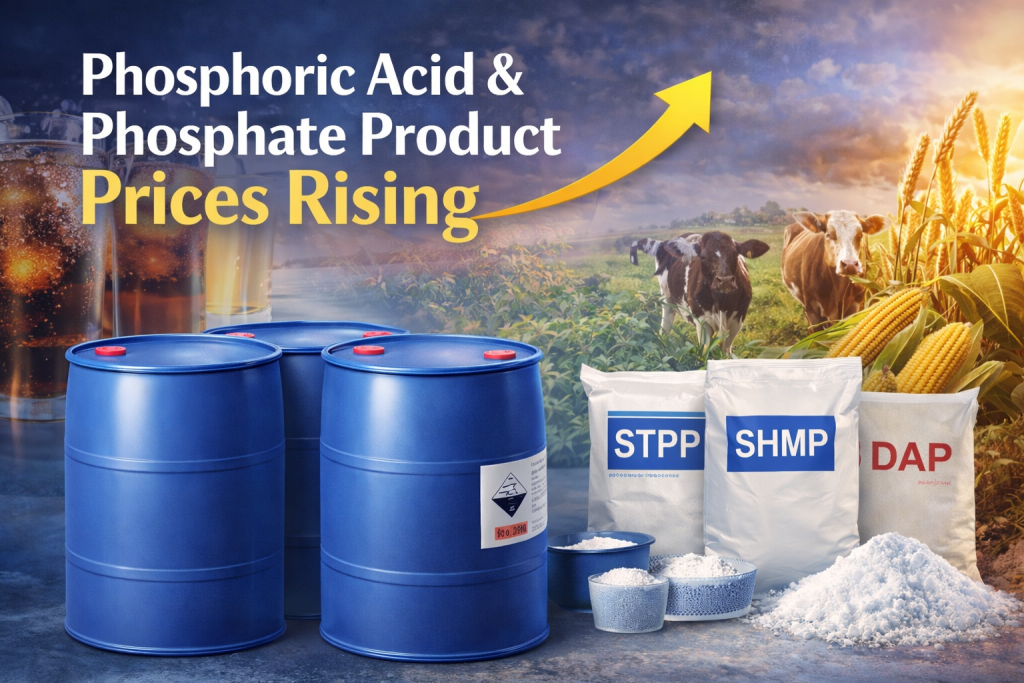
Phosphoric Acid Price Trend Since Q4 2025
Starting from Q4 2025, phosphoric acid prices began to rise noticeably across several regions. The price movement is mainly driven by:
- Rising upstream raw material cost (phosphate rock, sulfur, yellow phosphorus)
- Production constraints and environmental regulations
- Strong downstream demand recovery
- Expansion of the new energy sector
The recent price increase is not a short-term fluctuation but reflects structural tightening in the phosphate supply chain. To fully understand this trend, it is necessary to analyze the industry from upstream to downstream.
Market Insight: Phosphate Industry Chain Analysis
Upstream: Raw Materials and Supply Constraints
Phosphoric acid production mainly relies on several key raw materials:
- Phosphate rock
- Sulfur / sulfuric acid
- Yellow phosphorus (for thermal process acid)
- Energy (electricity, coal)
Any disruption in these raw materials directly impacts phosphoric acid supply and price. Phosphoric acid is primarily produced through two processes: thermal and wet.
- Thermal process: Uses yellow phosphorus and produces high-purity phosphoric acid, typically for food-grade and specialty applications, but with higher cost and energy consumption.
- Wet process: Uses sulfuric acid to decompose phosphate rock, allowing large-scale, lower-cost production, though with lower purity compared to thermal-process acid.
| Item | Thermal Process Phosphoric Acid | Wet Process Phosphoric Acid |
|---|---|---|
| Key Raw Materials | Yellow Phosphorus | Phosphate Rock + Sulfuric Acid |
| Cost | High | Low |
| Purity | High (Food / Electronic Grade) | Lower (Fertilizer / Industrial) |
| Energy Consumption | Very High (Electric Furnace) | Medium |
| Market Share | Small | Global Mainstream |
(1) Phosphate Rock Supply Tightening
Phosphate rock is a non-renewable strategic resource, and global reserves are highly concentrated. Mining restrictions, environmental policies, and resource protection strategies have limited supply growth in several countries. In China and other producing regions, stricter mining regulations and ecological protection policies have reduced new capacity expansion, making phosphate rock supply relatively tight and creating cost pressure throughout the phosphate chain.
(2) Yellow Phosphorus Price Volatility
Yellow phosphorus is a high-energy product and strongly influenced by:
- Electricity prices
- Environmental regulations
- Seasonal production limits
The sharp rise in yellow phosphorus price since late October 2025 has significantly increased thermal phosphoric acid production costs, which then transmits to phosphate chemicals such as STPP and SHMP.
(3) Sulfur and Sulfuric Acid Cost Pressure
Sulfur is a key feedstock for wet-process phosphoric acid. Global sulfur demand continues to rise due to agriculture and battery-metal extraction, while supply growth remains uncertain. Higher sulfur costs directly increase phosphoric acid production cost, pushing market prices upward.
(4) Energy and Environmental Restrictions
Phosphate production is energy-intensive and subject to carbon and environmental policies. Power costs, emission control, and capacity limits have restricted supply growth in recent years, contributing to tighter market conditions.
Midstream: Phosphoric Acid and Phosphate Products
Phosphoric acid is an intermediate product used to produce a wide range of downstream phosphate products across different industries, including:
- Agricultural phosphates: Provide nutrients for crops and improve soil quality (e.g., DAP, TSP)
- Industrial phosphates: Used in water treatment, corrosion inhibition, and surface protection (e.g., STPP, SHMP)
- Food-grade phosphates: Used for acidity regulation, preservation, and improving food texture and taste
- Specialty phosphates: Used in electronics, semiconductors, and new energy applications (e.g., high-purity phosphoric acid, lithium iron phosphate)
When phosphoric acid prices rise, production costs of all downstream phosphate products increase, leading to price movement across the entire phosphate industry. Phosphate chemical prices often move in tandem because phosphoric acid is the core feedstock.
Short-term Phosphoric Acid and Yellow Phosphorus Price Outlook (Jan–Apr 2026)
The global phosphoric acid market is expected to experience tight supply and upward price pressure in the short term. In November and December 2025, many phosphate plants underwent concentrated maintenance ahead of the Lunar New Year, causing a temporary drop in production and plant utilization. This dual decline contributed to higher phosphoric acid product prices.
Looking into January–April 2026, yellow phosphorus prices are likely to remain strong, supported by:
- Dry season production conditions keeping costs high
- Suppliers’ tendency to withhold material, supporting prices
- Concentrated plant maintenance gradually reducing the monthly supply–demand gap
- Downstream users increasing procurement and restocking before and after the holiday
Historical monthly price trends from 2015 to 2025 indicate that the first quarter of the year typically experiences seasonal price increases. Considering these patterns, both phosphoric acid and yellow phosphorus prices are expected to rise from January to April 2026.
Conclusion
Overall, the phosphoric acid market is currently supported by structural supply constraints, strong downstream demand, and price-driven upstream cost pressures. Stricter Chinese production policies have strengthened industry concentration, while the rapid expansion of the new energy sector—such as lithium iron phosphate production for batteries—has opened a secondary growth curve for phosphoric acid demand. These factors collectively enhance the overall profitability and outlook of the phosphate industry. Given the ongoing supply tightness and sustained demand, market conditions are expected to remain favorable, supporting a generally bullish price trend for phosphoric acid and its downstream products in the near to mid-term.
As a leading supplier in the phosphate industry, Niran Biochemical specializes in high-quality phosphoric acid, trisodium citrate, and other phosphate chemicals. With a focus on reliability, product purity, and customer-centric service, Niran Biochemical is well-positioned to support the growing needs of food, feed, agricultural, and new energy sectors. Our products and technical expertise help clients optimize production, improve efficiency, and stay ahead in a competitive market.
For companies seeking reliable phosphate solutions, Niran Biochemical is a trusted partner, offering consistent supply, competitive pricing, and long-term cooperation worldwide.