
What is MCT?
MCT is short for Medium-Chain Triglycerides. It can be understood as a type of fat mainly derived from natural sources like coconut oil and palm oil. The term “medium-chain” refers to the length of the fatty acid chains, which typically contain 6 to 12 carbon atoms.
In comparison, most common dietary fats—such as olive oil, soybean oil, and butter—consist mainly of long-chain fatty acids called Long-Chain Triglycerides (LCT), which usually have more than 12 carbon atoms.
In simple terms, the key difference between MCT and LCT lies in the chain length, which affects how they are digested and metabolized in the body. MCTs are absorbed more directly, transported to the liver for rapid metabolism, and quickly converted into ketone bodies to deliver energy to the brain and muscles. In contrast, LCTs require more complex digestion, lymphatic transport, and metabolic processing.
As a result, MCT is commonly selected for applications requiring fast energy availability, easier absorption, or reduced digestive burden.
What Is MCT Oil Powder?
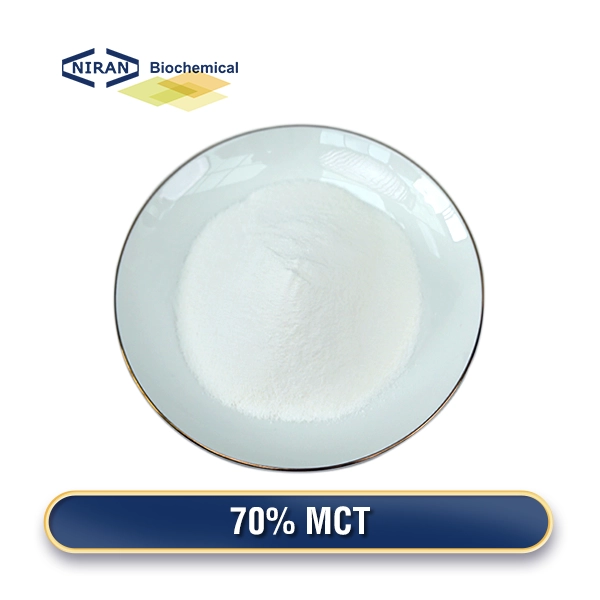
MCT Oil Powder is a powdered form of MCT oil that has been processed into a stable, free-flowing powder. It is usually a white or light-yellow powder made from MCT oil as the main raw material, combined with selected carriers and food-grade emulsifiers.
By batching, emulsifying, homogenizing, sterilizing, and spray-drying, manufacturers convert liquid MCT oil into a solid powder, making it easier to store, handle, and incorporate into a wide range of food and nutrition formulations.
MCT Oil Powder vs MCT Oil – Which Is Better?
MCT oil is perfect for liquid-based products, such as beverages, liquid nutrition, or oil-based formulations.
Meanwhile, MCT oil powder is produced by turning liquid MCT oil into a free-flowing powder using carrier materials.
This powdered form works well in dry or complex food systems where handling liquid oils can be tricky.
Although both share the same core lipid, their optimal applications vary depending on the product form and processing needs.
| Feature / Benefit | MCT Oil | MCT Oil Powder |
|---|---|---|
| Form | Liquid | Free-flowing powder |
| Optimal Applications | Beverages, liquid nutrition, oil-based products | Dry mixes, powdered beverages, bakery premixes, meal replacements, functional foods |
| Handling & Dosing | Standard liquid handling | Easier handling and dosing, especially for large-scale production |
| Stability During Storage | Stable but prone to oxidation if exposed to air/light | Better stability due to powder form and encapsulation |
| Compatibility with Dry Mixes | Limited; requires emulsification | Excellent; blends easily into dry or powdered formulations |
| Flow & Processing Efficiency | Liquid can be messy, may require special equipment | Free-flowing and non-greasy, improving processing efficiency |
| Dispersibility | Dissolves directly in liquid systems | Disperses well in hot or cold systems, ensuring uniform performance |
Key Functional Benefits of MCT Oil Powder
- Fast Energy Supply – Quickly metabolized into ketones for brain and muscle energy
- Easy Digestion – Gentle on the digestive system, suitable for sensitive populations
- Efficient Metabolism – Absorbed rapidly without complex digestion
- Neutral Flavor – Adds easily without changing the taste
- Stable and Clean – Powder form improves storage stability and product consistency
- Versatile Formulation – Works in both dry and liquid systems
Considerations and Common Questions About MCT
While MCT Oil Powder offers rapid energy, easy digestion, and formulation flexibility, there are some points to keep in mind:
- Weight Management: MCT may support satiety and energy metabolism, but results can vary between individuals.
- Digestive Tolerance: Most people digest MCT easily, but high doses may cause mild digestive discomfort such as bloating or diarrhea.
- Long-term Effects: Current studies are mostly short to medium term; the long-term health impact of large amounts of MCT is still under investigation.
By understanding these considerations, manufacturers and consumers can use MCT Oil Powder safely and effectively in a wide range of food and nutrition products.
MCT Oil Powder Uses
MCT Oil Powder is widely used due to its digestibility, energy-providing properties, and formulation flexibility. Its applications include:
1. Dietary Supplements
Its rapid metabolism into ketones and easy digestion make it ideal for supplements that require fast, sustained energy without adding digestive burden.
- Protein powders
- Meal replacement powders
- Sports and performance blends
- Keto or low-carb supplements

2. Functional Foods
Its neutral flavor, good solubility, and stability allow it to blend seamlessly into foods and beverages, enhancing energy content without affecting taste or texture.
- Energy-focused nutrition products (shakes, bars, beverages)
- Meal replacement shakes
- Keto-friendly foods (baked goods, snacks)
- General health-oriented foods
3. Sports Nutrition
Its fast absorption and conversion to ketones provide quick, sustained energy, making it suitable for endurance and performance-focused products.
- Pre-workout formulations
- Energy bars and snacks
- Sports beverages
4. Medical Nutrition & Special Foods
Its easy digestibility and rapid metabolism make it ideal for patients with fat malabsorption or special dietary needs, delivering essential energy without overloading the digestive system.
- Medical nutrition products for patients with fat malabsorption
- Therapeutic or specialized dietary foods
- Low-fat or ketogenic medical food formulations
5. Baby Foods & Infant Nutrition
Its gentle digestion and high-energy content make it suitable for infant and toddler formulas, supporting healthy growth and development without causing digestive discomfort.
- Infant formulas
- Follow-up formulas for toddlers
- Nutritionally fortified baby foods
Conclusion: A Convenient and Functional Energy Solution
MCT Oil Powder is a high-quality, microencapsulated form of medium-chain triglycerides suitable for modern dietary supplements, functional foods, sports nutrition, medical nutrition, and infant products. Its ease of handling, excellent dispersibility, neutral flavor, rapid energy delivery, and storage stability make it a versatile, practical, and efficient ingredient for manufacturers seeking to provide high-performance, consumer-friendly products.