
Xanthan gum is a highly versatile additive widely used across food, pharmaceutical, cosmetic, and industrial products. Although most consumers may not recognize its name, they interact with it daily through foods like salad dressings, gluten-free baked goods, sauces, and even personal care products.
What Is Xanthan Gum?
After fermentation, the resulting goo is precipitated with alcohol, dried, and milled into a fine powder that dissolves easily in water.
Chemically, xanthan gum is made up of repeating sugar units including glucose, mannose, and glucuronic acid. The molecular structure gives it exceptional ability to influence the flow and texture of liquids and semi-solids.
In regulatory terms, xanthan gum is known as food additive E415 and has been approved for use in foods by major authorities such as the U.S. FDA and European EFSA.
Key Properties
Solubility and Rheology
Xanthan gum dissolves in both cold and hot water and forms viscous solutions even at low concentrations. When mixed with liquid, it hydrates rapidly without the need for heat, making it highly effective in many formulations.
Viscosity and Shear-Thinning
Xanthan gum solutions thin under shear and regain viscosity when at rest. This property is especially valuable in foods like salad dressings that should pour easily but cling to leaves once on the salad.
Stability Across Conditions
Xanthan gum maintains stability across a wide pH range (approximately pH 5–10) and in both hot and cold environments. It also resists enzymatic breakdown and maintains uniformity under mechanical stress.
Interaction with Other Hydrocolloids
Xanthan gum works synergistically with guar and locust bean gums to strengthen texture.
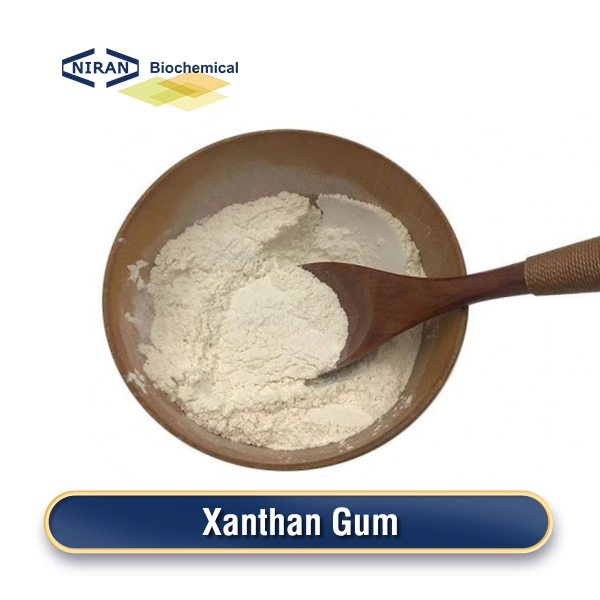
How Xanthan Gum Is Produced
Fermentation
The production process begins by fermenting sugars (such as glucose or sucrose) with Xanthomonas campestris. During fermentation, the bacterium secretes xanthan gum into the liquid medium.
Precipitation and Recovery
Isopropyl alcohol precipitates the polymer, which is then separated, washed, and dried.
Drying and Milling
The dried gum is milled into a fine powder that can be easily dispersed in water or other liquids during formulation.
Because it is a microbial product, xanthan gum is considered a biotechnologically produced ingredient, which helps make it acceptable for vegan, vegetarian, halal, and kosher markets when processed accordingly.
Applications Across Industries
Xanthan gum’s unique properties make it useful in a broad range of industries, from food processing to drilling fluids.
Food & Beverage Industry
In food applications, xanthan gum functions primarily as a thickener, stabilizer, and texture modifier:
- Sauces and Dressings: Prevents oil-water separation and keeps spices suspended uniformly.
- Baked Goods: Replaces the elastic properties of gluten in gluten-free baking, helping dough bind and retain moisture.
- Dairy & Beverages: Adds body to products like ice cream, yogurt, and drinks, enhancing mouthfeel.
- Frozen Foods: Reduces ice crystals, preserving texture through freeze–thaw cycles.
Because xanthan gum works effectively at low concentrations (often <1%), it’s economical and doesn’t change flavor or color.
Pharmaceuticals
Within pharmaceuticals, xanthan gum serves to:
- Suspend active ingredients in liquid medications.
- Control release rates in extended-release tablets.
- Stabilize syrups and emulsions.
Its strong hydration capacity and proven safety support oral and topical use.
Cosmetics & Personal Care
Xanthan gum helps improve texture, stabilize emulsions, and enhance product consistency in:
- Lotions and creams
- Toothpaste
- Shampoos and conditioners
- Facial masks
Although it doesn’t provide direct therapeutic skin benefits, it improves consumer experience by preventing ingredient separation and improving spreadability.
Oil & Gas Industry
In oil drilling fluids (muds), xanthan gum:
- Maintains stable fluid viscosity under extreme heat and pressure.
- Suspends cuttings to carry them to the surface.
- Improves borehole cleaning efficiency.
Its thermal stability and shear-thinning behavior are critical in these demanding environments.
Industrial and Other Uses
Beyond food and pharma, xanthan gum appears in:
- Paints and coatings: Maintains pigment dispersion and enhances coating application.
- Adhesives: Improves thickness and maintains consistent bonding performance.
- Textile Printing: Functions as a thickener for dyes and pastes.
- Agriculture: Acts as a binder in seed coatings and controlled-release fertilizer matrices.
Safety and Regulatory Status
Xanthan gum is FDA-approved as safe for food use. It has been approved for food use since the late 1960s and is accepted in many global jurisdictions, including the EU and Canada.
As a soluble fiber, xanthan gum can aid digestion in small amounts, but excessive intake may lead to bloating, gas, or loose stools in sensitive individuals.
In pharmaceutical and cosmetic uses, it is typically safe when formulated appropriately, but products should always be used according to label directions.
Handling and Storage
- Dispersion Tips: To avoid lump formation, disperse xanthan gum slowly into the liquid while stirring or use high-shear mixers.
- Personal Safety: Usually safe to handle, but like any powder, avoid inhalation. Wear simple dust protection if handling large quantities.
Environmental and Sustainability Considerations
Xanthan gum is derived from renewable biomass sources (sugars) through microbial fermentation, making it more sustainable than many petroleum-based thickeners. Its use in low concentrations also reduces ingredient load and waste.
Because it biodegrades naturally, xanthan gum does not remain in the environment long.
Substitutes and Alternatives
Depending on the application, alternatives to xanthan gum include:
- Guar Gum: Good thickener with a creamier mouthfeel in dairy products.
- Locust Bean Gum:Improves gel firmness when combined with xanthan in dairy products.
- Psyllium Husk / Chia Seeds: Natural fiber options in baking.
- Carboxymethyl Cellulose (CMC): A cellulose derivative used in food and cosmetics.
Conclusion
Xanthan gum is a multifunctional ingredient widely used across food, pharmaceutical, cosmetic, and industrial fields, valued for its reliable thickening, stabilizing, and texture-enhancing performance.
With robust safety profiles and broad regulatory acceptance, xanthan gum will continue to play a crucial role in product development and quality enhancement across industries.
Whether you’re a food technologist, product developer, formulator, or curious consumer, understanding xanthan gum’s properties and applications empowers smarter decisions in recipe design and product innovation.